Is there a right number of hours?
No single number works for everyone, and hours alone do not predict progress. In a 2009 study, 17 graduate and advanced undergraduate piano majors practiced a difficult three-bar passage from a Shostakovich concerto until they felt ready, then played it again the next day. Practice time and the number of repetitions were not related to how well they played the next day. What mattered was how often they played the passage correctly during practice.
So start from how you practice, then decide how long.
How much should you practice by level?
A workable starting point for each stage:
| Who you are | Daily practice | What matters most |
|---|---|---|
| Hobby player | Short, as often as possible — 10 minutes every day | Frequency over length |
| Entrance-exam student, also studying | Around 5 hours, in blocks | Planning the day around school |
| Music major | Your own routine, every day | Consistency |
| Everyone | Lengthen focus a little at a time | Planned breaks and stretching |
The same principles hold for piano, strings, winds, voice and guitar (acoustic and classical).
Is 10 minutes every day better than an hour once a week?
Yes, for most hobby players. Many people practice in bursts on the days they feel motivated and then skip several days. Ten minutes every day keeps the work going and gives your memory time to settle between sessions.
A small laboratory study points the same way. Twenty-nine musicians who were not pianists learned a short nine-note sequence on a keyboard in three sessions spaced 5 minutes, 6 hours or 24 hours apart. Only the group with a full day, and a night's sleep, between the first two sessions became more accurate in the second session.
How do exam students fit practice around school?
Students preparing for music entrance exams often struggle with how to divide the day between practice and schoolwork. If you are also studying, around five hours of practice a day is a reasonable baseline. Split it into blocks — for example a morning block before school and two blocks in the evening — and decide in advance what each block is for, so the hours do not blur together.
How long do people actually practice in one sitting?
That is shorter than many people picture when they think of a practice day, and it is a useful reality check: a long day is usually several sessions, not one.
How long should one session be, and when should you rest?
Long, unfocused practice is less useful than shorter, focused blocks with planned breaks. Notice how long you can stay focused today, then stretch it a little at a time. Decide your break interval in advance instead of waiting until you are tired, and use part of each break for a short stretch — it helps your posture and your concentration.
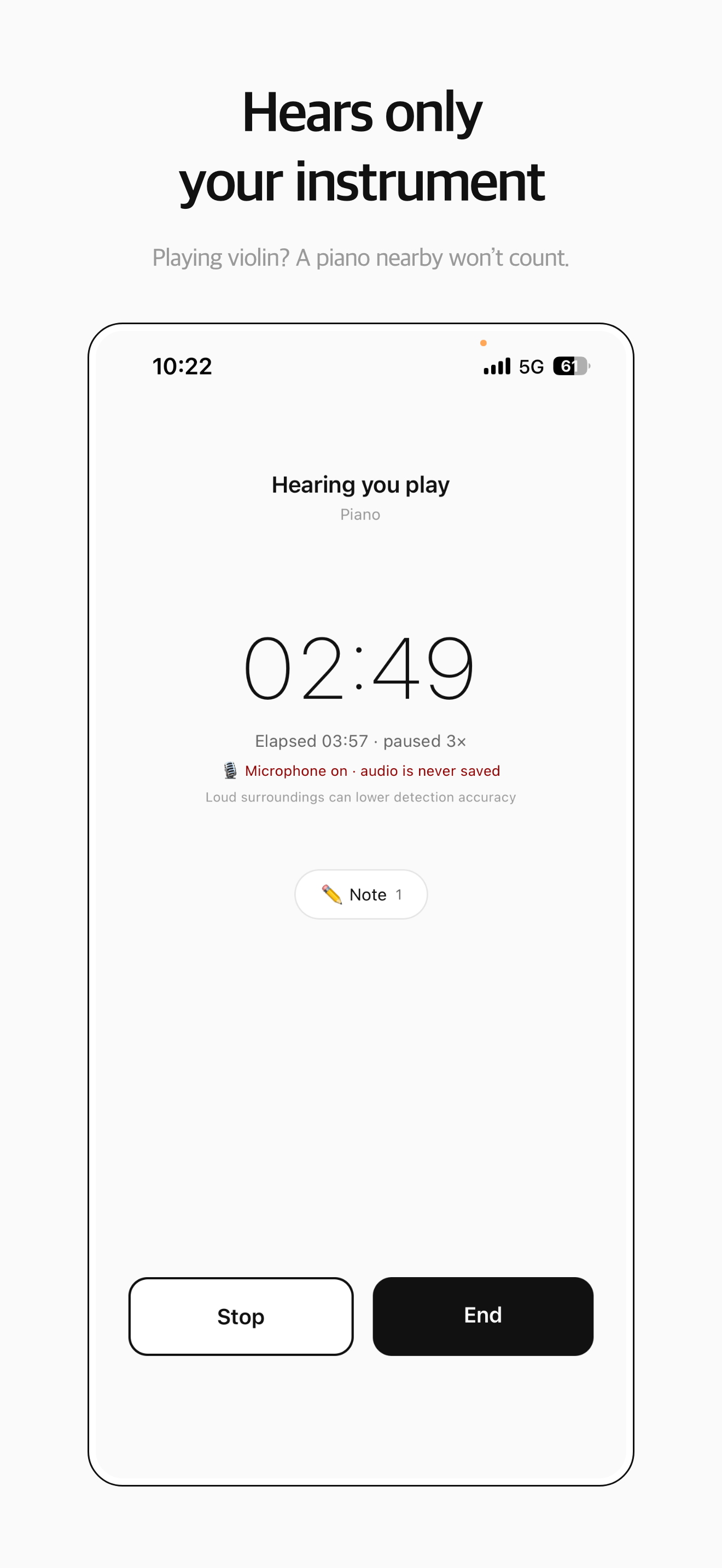
Because MU:note leaves out silences longer than 15 seconds, your daily total shows the time you were actually playing, which makes it easier to see whether your focus is growing.
If you want to make each block count, read how to practice more efficiently, and keep a short practice journal so you can see your own pattern over weeks.