Why keep a practice journal?
A practice journal tells you how much practice a piece takes you. The day you have to get a new piece ready by a fixed date, your past entries show roughly how many weeks, how many minutes a day, and which kinds of practice it took last time. Without that record, planning is guesswork.
It also turns practice into something you can look back on. Most of us remember how a session felt, not what we did in it.
What should you write after each session?
Write five things, briefly:
- How long you played — the minutes you were actually playing, not the time you sat at the instrument.
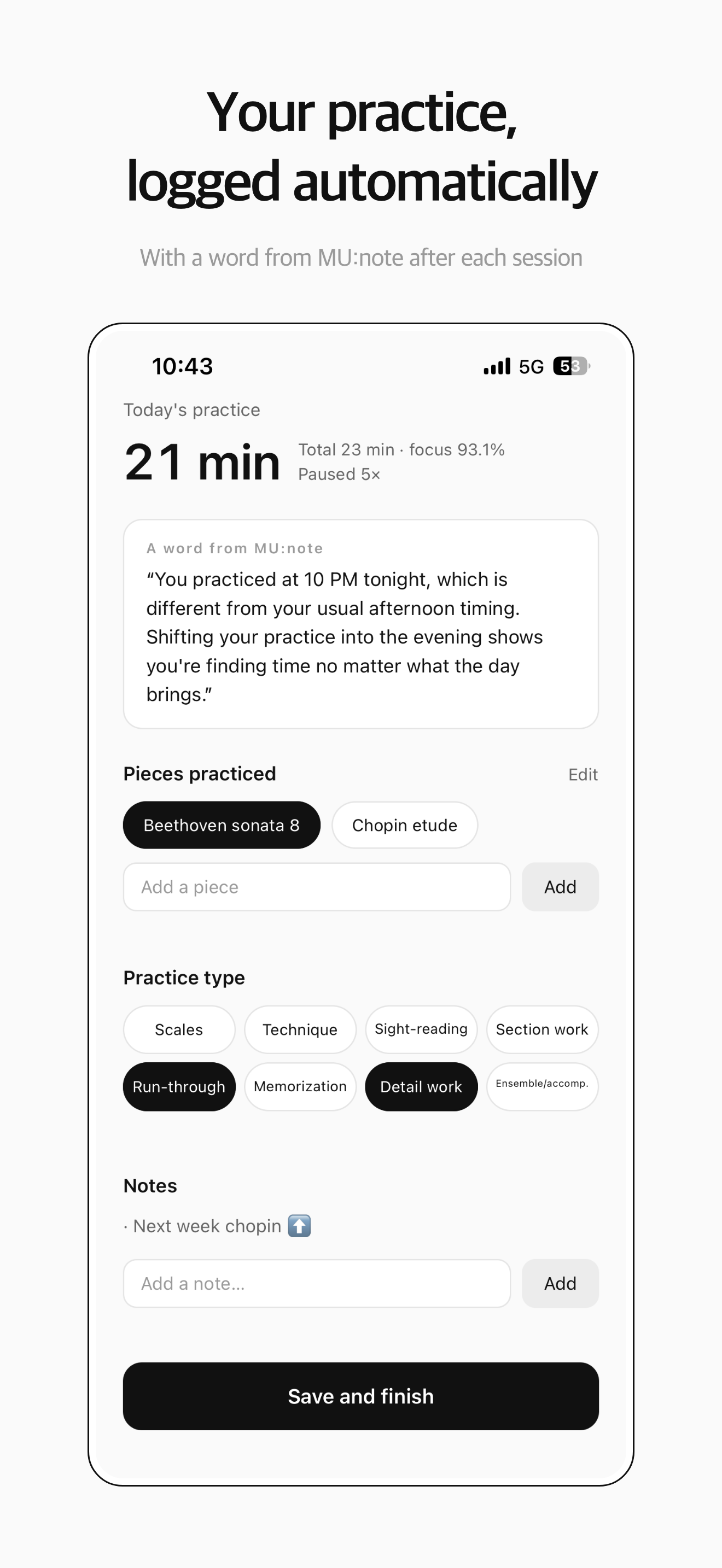
- Which piece, and what kind of practice — for example scales, technique, section work, detail work, sight-reading, memorization, run-throughs, or ensemble and accompaniment.
- Whether you finished your to-do list — what you planned for the session, and what got done.
- Where you got stuck, and where you broke through — the bar, the passage, the shift.
- The method you used — slow practice, rhythm variations, hands separately, recording yourself. Write down what worked so you can use it again.
An example entry looks like this:
| Date | Piece and practice type | Minutes played | To-do list | Stuck / broke through | Method |
|---|---|---|---|---|---|
| Oct 14 | Chopin Ballade No. 1, section work | 48 | 2 of 3 done | Coda leaps still uneven / bars 9–16 now even | Slow practice with dotted rhythms |
Can you trust your memory of how long you practiced?
Not reliably. In a study published in 2004, music education researcher Clifford Madsen compared the detailed daily practice records students had kept 30 years earlier with what they later remembered. Their recollections did not match their own records. The same study found that the link between how much they had practiced and the highest level they reached was not strong — which is one more reason to write down what kind of practice you did, not only how long.
Even within a single session, the clock is misleading. Time at the instrument includes page turns, water breaks and checking your phone.
Why do most musicians only keep one before a big performance?
Because that is when the pressure is visible. When we talked with musicians testing MU:note, many said they kept a journal only before an important performance or exam.
That still helps, but it misses the main payoff. The entries that teach you the most are the ordinary weeks: they show how a piece moves from first reading to ready when nothing special is happening. A short entry on an ordinary day is worth more than a long one written once a semester.
How do you use your journal to plan for a deadline?
Start from the last piece you finished. Count the weeks from first reading to performance, the typical minutes per day, and which kinds of practice took most of the time. Then plan the new piece backwards from its date, adjusting for length and difficulty.
For example, if a previous movement took about six weeks at around 45 minutes a day, mostly section work and run-throughs, a movement of similar length needs a similar runway — and you will know early if you are behind.
Paper, spreadsheet, or app?
Pick whatever you will keep using. A notebook is fine; so is a spreadsheet. If writing the minutes is the step you skip, let MU:note count them: it hears the instrument you set and keeps only the time you actually played, so you only add the piece, the practice type and a note.