Is stage fright a sign that you are not prepared?
No. Stage fright is common among musicians at every level. In a 1987 survey of musicians in major US orchestras, stage fright was the most common problem reported, and 27% of those who responded said they had used beta blockers — 70% of them without a prescription. We mention this not to talk about medication, only to show how common the experience is.
Why does stage fright hit musicians so hard?
Because the work you have done is invisible. On stage, months of practice come down to a few minutes, and there is nothing in front of you that shows how much you have prepared. With nothing visible to hold on to, your mind fills the gap with doubt.
Research points in the same direction. In a study of 270 musicians, both students and professionals, those with higher performance self-efficacy — confidence in their own ability to perform — reported lower music performance anxiety. Seeing a concrete record of your preparation is one way to support that confidence.
How do you make your preparation visible?
Keep a record of what you practiced, then look at it before the performance:
| When | What to do |
|---|---|
| Every day | Note the piece, the kind of practice and the minutes you actually played |
| Each week | Read the week back and write one thing that improved |
| The night before | Look over the weeks of preparation, not just yesterday |
| Right before you go on | Remind yourself of one concrete thing you know you can do |
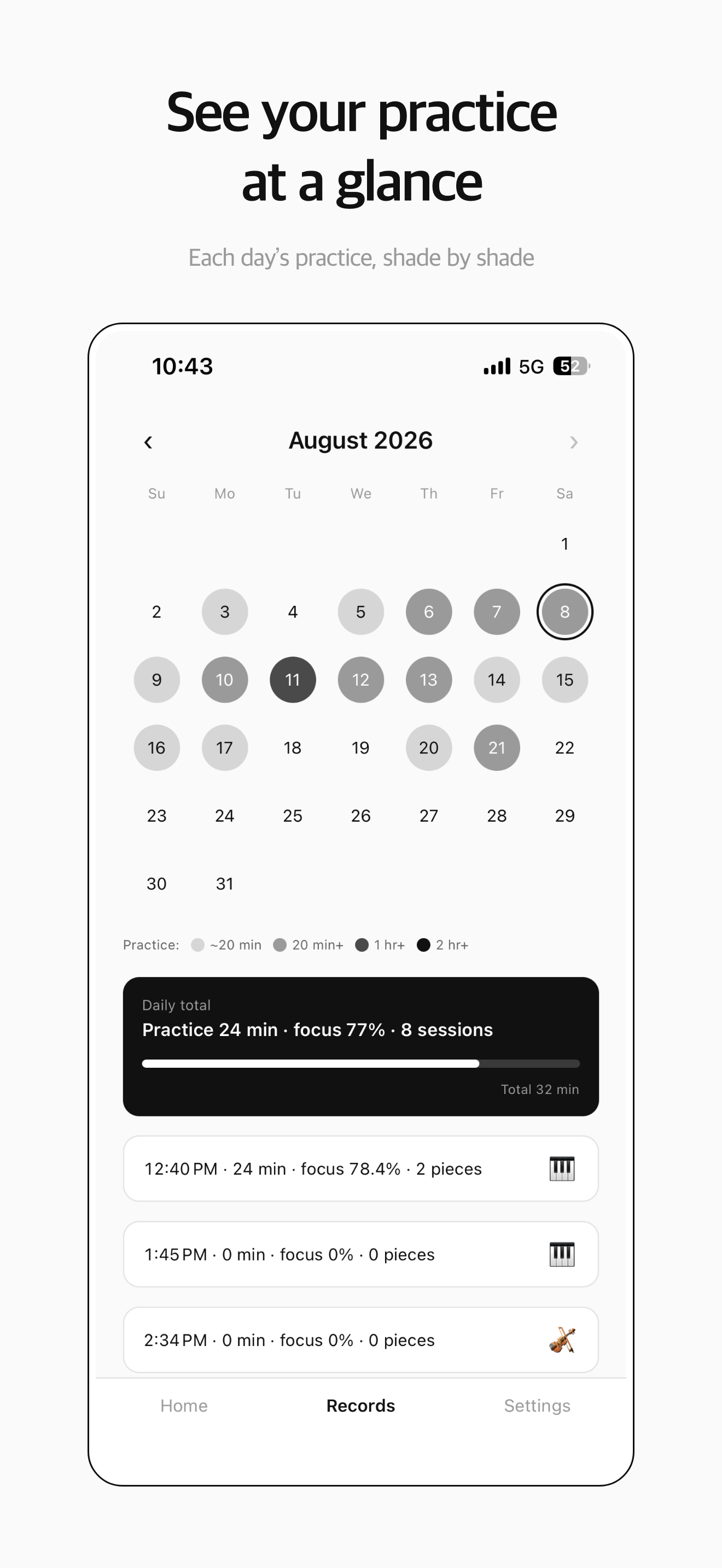
A short practice journal is enough. The point is that on the day, you have something real to look at instead of a vague feeling that you have not done enough.
MU:note makes this visible without extra effort: it counts the time you actually played, day by day, and shows it on a calendar you can look back on before you walk on stage.
Can you practice performing, not just the piece?
Yes, and it helps to treat it as its own skill. Play run-throughs for a friend, your family or a small group, in the clothes you will wear, starting cold the way you will on the day. Research supports rehearsing the situation, not only the music: in a 2014 study, advanced violinists who performed in a simulated recital and a simulated audition reported anxiety comparable to a real audition and rated the simulation useful for learning to manage performance anxiety. The study was small, but the idea is practical — the more familiar the situation, the less room it has to surprise you.
For how to prepare the piece itself, see how to practice more efficiently.
What can you learn from performers who struggled?
That struggling is not the end of the story.
- Vladimir Horowitz walked away from the stage after a recital in February 1953 and stayed away for twelve years. He returned at Carnegie Hall on May 9, 1965. He stepped back from performing several times in his life and came back each time.
- Renée Fleming was booed at La Scala in 1998 in Lucrezia Borgia, and returned to the same theatre seven months later. She has written about her own stage fright in her memoir, The Inner Voice (2005).
- Sergei Rachmaninoff is often mentioned here, but his story is different: it was a creative block, not stage fright. After the failed 1897 premiere of his First Symphony he could hardly compose, and in early 1900 he saw Dr. Nikolai Dahl almost daily. He recovered and dedicated his Second Piano Concerto to Dahl.
None of them was unprepared. They came back with time, support and a plan.
When should you get help?
If anxiety stops you from performing, or spills over into the rest of your life, talk to your teacher and to a doctor or psychologist. Getting help is part of preparing, not a sign of weakness.